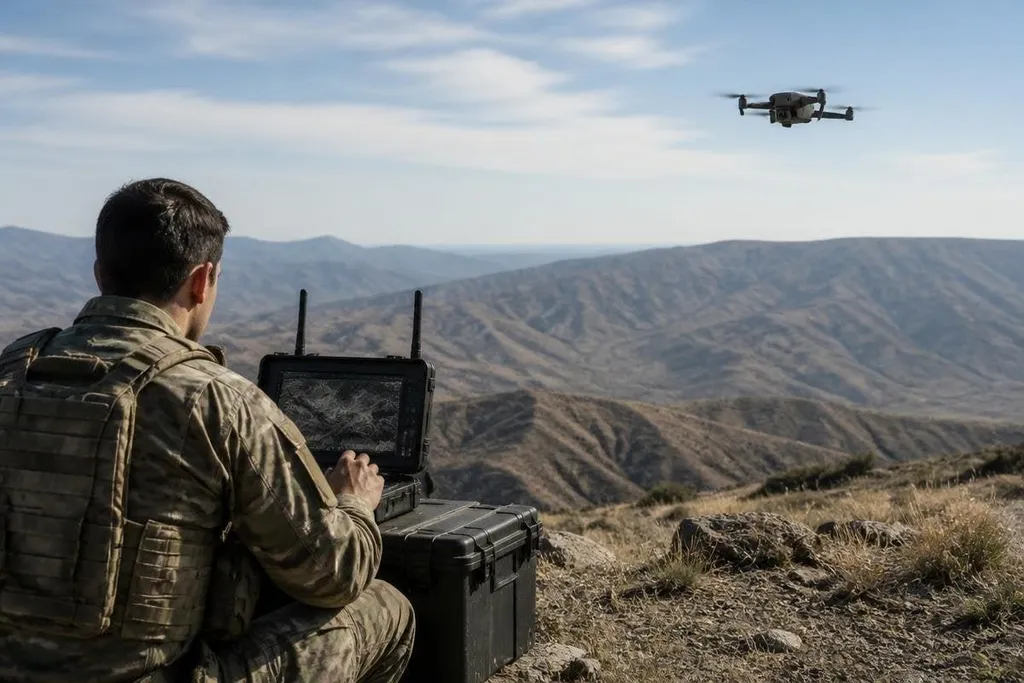
A small drone can give a military unit a view beyond the next ridge without sending a crewed aircraft into the same space. That changes how commanders gather information, plan attacks, protect vehicles, and judge risk. The hardware matters, but the larger change sits in the decisions around it.
Quick read
- Drones shorten the gap between seeing a target and acting on that information.
- Cheap systems can force costly defenses, but they still need people, software, and secure links.
- Drone use works best as part of a wider force, not as a replacement for every aircraft or soldier.
From large platforms to many small ones
Traditional air power often depends on a small number of costly aircraft. Many small systems can spread work across several airframes, with each one carrying a sensor, a radio, or a weapon suited to a narrow task.
That changes the cost of a mistake. Losing one drone can remove a useful tool, but it may not remove the whole mission. A commander can send several systems to watch different routes, check a position, or test an opponent's response.
Control is the trade. Each drone needs a launch plan, a communications link, trained operators, and a way to return useful data to the unit that needs it.
More aircraft can mean more choices, but it can also create more work in the command network.
Speed changes the decision cycle
The camera or thermal sensor on one drone can send information to a remote operator. That operator can pass the image to a command team, which may then change the next move. The value comes from reducing the time between observation and action.
This process is often called the decision cycle. Drones can shorten parts of it, but they don't remove the need to confirm what the sensor shows. Smoke, weather, distance, camouflage, and image quality can all make a view hard to read.
The link itself is a weak point. Jamming can break the connection, while interference can delay or distort the data. Systems that work well in a test area may behave very differently when the radio space is crowded or contested.
A lost link can leave a force choosing between another drone and a human team. Defense robotics reporting from Robot24.com can tie that result to the drone, radio conditions, test date, and operator action. Those details lead into the next problem: cheap attacks can force expensive choices.
Cheap attacks create expensive choices
Some drones can carry a small payload or guide another weapon toward a target. Others may serve as decoys, forcing an opponent to reveal a radar or spend ammunition. That gives a drone value even when it never reaches its target.
The cost problem runs in two directions. A low-cost drone may demand a response from a much more expensive interceptor, while a defensive unit that saves ammunition may leave a target exposed. Strategy now includes the question of how much protection a target deserves and how much defense it can consume.
This does not make drones disposable in every case. A system with a better camera, longer range, or secure communications link may cost much more than a basic aircraft. The right choice depends on the job and the risk of losing it.
People still carry the burden
Autonomy can help a drone hold a route, avoid obstacles, or return home after a lost signal. Those functions reduce the operator's workload. They don't settle the harder questions about target identity, civilian risk, or when force is allowed.
Running a drone force also needs maintenance crews, spare parts, batteries or fuel, software updates, and training. Weather and terrain still matter. A system that depends on a clear signal or a fragile airframe may fail when the conditions change.
I'd judge a drone program by the full chain around the aircraft, not by a polished flight video. The aircraft is one part of a system that includes people, radios, data, command rules, and repair capacity.
A practical decision guide
Before treating a drone as a major change to military planning, check:
- Mission: Does the drone watch, carry, relay, deceive, or strike?
- Control link: Can the operator keep contact in the expected operating area?
- Data path: Who receives the sensor feed, and how fast can they act on it?
- Defense cost: What response does the drone force from the opposing side?
- Recovery plan: Can crews repair, replace, or retrieve the system after a loss?
These questions point to the next stage of drone strategy. The advantage will depend less on owning an aircraft than on connecting many small decisions without losing control of the wider mission. The open question is how well those systems work when communications fail and the information arrives incomplete.